
How ATS and Hiring AI Algorithms Work (Why 75% of Resumes Are Rejected)
Understand the automated filter between your application and the recruiter's desk. Insights from Harvard Business School research on recruiting software.
We have all received that automated rejection a few hours after applying:
"Thank you for your interest. While your qualifications are impressive, we have decided to move forward with other candidates..."
Most people assume a recruiter made that call. The reality is usually different: no human ever opened your application.
Harvard Business School's "Hidden Workers: Untapped Talent" study found that Applicant Tracking Systems reject more than 75% of qualified applicants — not because they lack the skills, but because of mechanical and formatting failures in the document itself.
Step-by-Step Walkthrough
Document Ingestion & Text Layer Extraction
ParsingThe system strips vector coordinates, font weights, and character strings from your PDF or DOCX.
Section Classification & Header Mapping
SectioningHeaders are matched to database entities (Work History, Education, Skills, Contact).
Semantic Keyword Comparison
MatchingJob description requirements are matched against your candidate bullets using keyword density and semantic context.
Candidate Scoring and Shortlist Generation
RankingOnly the top 5-10% of applicants receive review from human hiring managers.
// TABLE OF CONTENTS
- 01.1. What an Applicant Tracking System Actually Is
- 02.2. How the Algorithm Scores Your Resume
- 03.3. Rules That Keep You in the Shortlist
- 04.4. Test Your Resume Against a Real ATS Simulation
- 05.5. What the "AI" in Hiring AI Actually Does
- 06.6. Myths Worth Discarding
- 07.7. Reading the Parse Yourself
- 08.8. What Changes at Different Company Sizes
- 09.9. The Timeline Problem Most Candidates Miss
1. What an Applicant Tracking System Actually Is
An ATS is enterprise software that automates hiring workflows. The systems you are most likely being screened by are Workday, Greenhouse, Lever, Taleo and SAP SuccessFactors.
Their job is arithmetic. When one opening attracts 1,000 applications, no recruiter can read 1,000 resumes. The ATS parses, scores and ranks every submission, then surfaces roughly the top 15 to 20 candidates. Everything below that line is archived without review.
2. How the Algorithm Scores Your Resume
A. Parsing
The system first strips raw characters out of your file. Parsing breaks when the document contains:
- Two-column layouts or invisible tables — a phone number in the left column fuses with a company name from the right.
- Section headings rendered as images or icons instead of selectable text.
- Decorative symbols, progress bars and vector drawings.
B. Timeline Reconstruction
The parser reads employment dates (January 2021 – March 2023) to compute total years of experience. Inconsistent date formats or scrambled ordering make the system calculate your tenure as zero — and seniority filters then drop you automatically.
C. Keyword and Role Matching
If the posting mentions "PostgreSQL" and "microservice architecture", the ATS checks whether those exact terms appear in your skills or experience sections. The higher the overlap, the higher you rank.
3. Rules That Keep You in the Shortlist
- Single-column hierarchy. Avoid the two-column, chart-heavy templates that look impressive on screen. A plain top-to-bottom structure is what parsers read most reliably.
- Conventional section headings. Write "Work Experience", not "What I've Been Up To". Creative headings prevent the parser from mapping your content to the right field.
- Standard fonts. Stick to fonts every system resolves correctly: Arial, Calibri, Cambria, Georgia, Helvetica, Times New Roman, Inter, Lato or Open Sans.
- Bullets containing numbers. Percentages, budgets, headcounts and time savings give ranking algorithms something concrete to score.
4. Test Your Resume Against a Real ATS Simulation
Resuzu Analyzer reproduces how modern parsers actually behave, running 36 deterministic rules over your file:
- 8 mechanical checks — scannability, column layout, font family and size, embedded graphics, contact placement, page density, file name.
- 18 content and structure rules covering sections, dates, personal data, skill grouping and section ordering.
- 5 Action-Scale-Outcome (ASO) checks that measure the depth of your experience bullets.
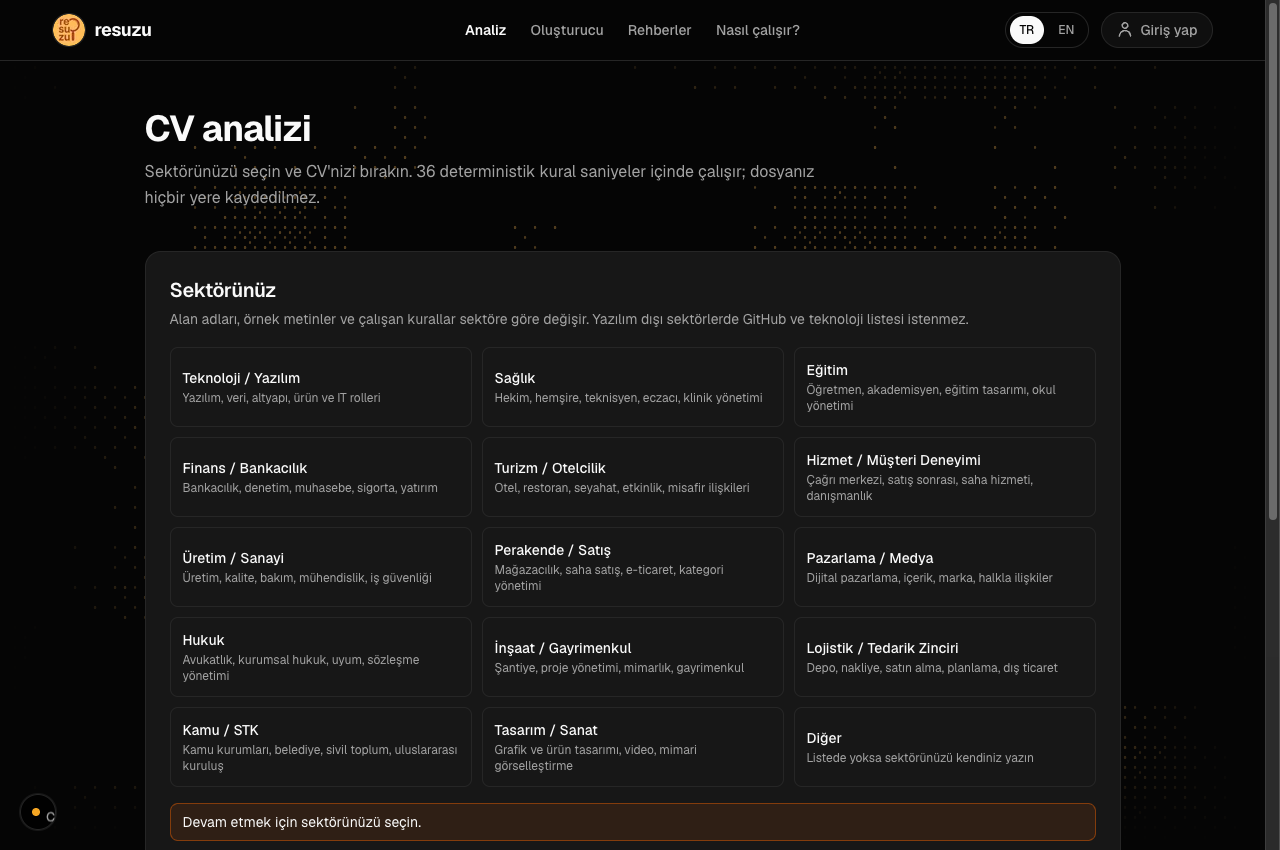
The same resume always produces the same score — the engine is deterministic, so you can fix one issue at a time and watch the number move.
5. What the "AI" in Hiring AI Actually Does
Vendors describe their products as AI-powered, and the phrase covers three very different things. Knowing which one you are facing changes what you should optimise for.
Deterministic parsing. Extracting characters, coordinates, fonts and link annotations from a file. No model is involved; it is engineering, and it either succeeds or produces garbage. This layer decides whether you exist in the database at all.
Statistical matching. Comparing the vocabulary of your document against the vocabulary of the posting. Older systems do literal keyword matching; newer ones use embeddings, so "Postgres" and "PostgreSQL" register as related, and "led a team of eight" registers as evidence of management. Embeddings are more forgiving of synonyms, but they still cannot infer a skill you never mentioned.
Ranked shortlisting. Combining match score with filters — years of experience, location, work authorisation, salary expectation — into an ordered list. A recruiter opens that list from the top.
The practical consequence is a strict ordering of effort. No amount of keyword optimisation rescues a document that failed to parse. Fix the mechanics first; tailor the vocabulary second.
6. Myths Worth Discarding
"White text keywords trick the system." They do not. Parsers extract characters regardless of colour, so the hidden block lands in the same text the recruiter can read in the parsed preview. When it is found — and it is routinely found — the application is discarded and, at larger employers, flagged.
"PDFs are always rejected; send a Word file." This was true of some systems a decade ago. Today the major platforms handle both. What matters is the internal structure, not the extension: a single-column PDF with a real text layer parses more reliably than a DOCX built out of invisible tables.
"The ATS rejects you automatically if you score below a threshold." Most systems do not auto-reject on score; they rank. The effect is the same — nobody reads position 340 — but the mechanism matters, because it means there is no magic number to clear, only a position to improve.
"Applying to more jobs improves the odds." Volume without tailoring lowers your average match score across every application. Ten targeted applications reliably outperform a hundred generic ones.
7. Reading the Parse Yourself
You do not have to guess how a system sees your document. Two checks take under five minutes.
The first is manual: open your PDF, select all, paste into a plain text editor. The order and content of that paste is close to what a parser extracts. If your job titles appear interleaved with your skills list, you have a column problem.
The second is the analyzer. Resuzu reproduces the parsing layer with real coordinate and font data, then reports what broke and where — including an overlay that marks the exact position of each finding on your document. Because the engine is deterministic, the number moves only when the document changes, which makes it usable as a feedback loop rather than a verdict.
8. What Changes at Different Company Sizes
The screening you face is not uniform, and tailoring your effort to the likely pipeline is worth more than a generic optimisation pass.
Large enterprises (1,000+ employees). Almost certainly Workday, Taleo or SuccessFactors, almost certainly with a portal that re-parses your PDF into structured fields you then have to correct by hand. That correction screen is a gift: it shows you exactly what the parser extracted. If the fields come back scrambled, your document has a mechanical problem that will also affect every other application you send.
Mid-size companies (100–1,000). Usually Greenhouse or Lever. Parsing is generally better, screening is a mix of automated filtering and a recruiter skimming, and keyword overlap matters more than raw mechanics — though mechanics still decide whether your text exists.
Small companies and startups (under 100). Often a shared inbox or a lightweight tool. A human very likely opens your file. Mechanics still matter, because a broken PDF looks careless, but the reading is human and the summary paragraph carries more weight than anywhere else.
Agencies and recruiters. They maintain their own databases and search them months later. This is the one case where broad, accurate keyword coverage genuinely pays: you want to be findable for a role that does not exist yet.
9. The Timeline Problem Most Candidates Miss
Section 2B mentioned that the parser reconstructs your employment timeline. That reconstruction is worth understanding in detail, because it fails silently and the consequences are large.
Seniority filters are among the first applied, and they run on computed years of experience, not on what your summary claims. If the parser cannot read your dates, computed experience is zero and a filter for "5+ years" removes you before any human sees the file.
Dates fail to parse for mundane reasons. Letter-spaced typography in design templates writes "0 9 . 2 0 2 3" as separate characters. Two date formats in one document make the pattern ambiguous. A date placed in a right-hand column far from its job title may be associated with the wrong role, or with none. An entry with a title and a company but no dates at all — Resuzu's GEN-04 — is invisible to the timeline calculation entirely.
The fix is unglamorous: one date format, written as text, on the same line or the line directly below the role it belongs to, for every entry including education.
Rules Referenced in This Guide
All 36 rules →Every rule has its own inspector card, evidence sample and fix steps.
Test If Your Resume Beats ATS Filters
Upload your resume to Resuzu Analyzer and audit it across 36 deterministic parsing and content rules in seconds.
Frequently Asked Questions
Which systems use automated ATS screening?
Workday, Taleo, Greenhouse, Lever, iCIMS, and SAP SuccessFactors power the vast majority of enterprise recruitment pipelines.
Does white text trick ATS algorithms?
No. Modern parsers inspect font colors and inline CSS styles. Using invisible text can result in automatic blacklisting.
Related Guides
View All →Why Canva Resumes Fail ATS Screenings (Design vs. Parseability)
Eye-catching colors and two-column layouts look great to humans, but what happens when hiring bots try to read them?
How to Build an ATS-Friendly Resume Step-by-Step (2026 Guide)
A comprehensive walkthrough on crafting a professional resume that passes automated Applicant Tracking Systems and impresses recruiters.
How to Read Your Resume Analysis Report (Decoding Rule Codes & Warnings)
A step-by-step walkthrough for interpreting Resuzu audit reports, prioritizing hard blockers, and understanding ASO bullet scores.