
How to Boost Your Resume ATS Score from 60 to 90+ (Proven ASO Formula)
Transform a mediocre resume into an elite application using Google's X-Y-Z principle and the Action-Scale-Outcome (ASO) methodology.
In Work Rules!, Google's former SVP of People Operations Laszlo Bock reduces the anatomy of a strong resume bullet to a single formula:
"Accomplished [X], as measured by [Y], by doing [Z]"
Resuzu extends that idea into a scoring system we call ASO — Action, Scale, Outcome. Applying all three components to every experience bullet is the fastest reliable way to move a resume from the 60s into the 90s.
Step-by-Step Walkthrough
Eliminate Passive Verbs
1: ActionReplace 'assisted with', 'was responsible for', and 'participated in' with active verbs like 'Spearheaded', 'Engineered', 'Optimized'.
Inject Scope and Scale Metrics
2: ScaleQuantify the magnitude: team size, budget, volume of requests, or thousands of active users.
Specify Tangible Business Outcomes
3: OutcomeDetail what happened as a result: decreased latency by 45%, generated $120k revenue, saved 10 hours weekly.
Apply Consistently Across All Roles
CompleteEnsure each role has at least 3 high-impact, ASO-aligned bullet points.
// TABLE OF CONTENTS
- 01.1. The Three Components
- 02.2. Before and After
- 03.3. Why Vague Bullets Lose Points
- 04.4. Live ASO Feedback While You Write
- 05.5. Where to Find Numbers When You Think You Have None
- 06.6. Verbs That Carry Weight, and the Ones That Do Not
- 07.7. Score Arithmetic — Where the Points Actually Live
- 08.8. Rewriting Without Inflating
- 09.9. A Practical Rewrite Session
1. The Three Components
Action
The first word of the bullet, and the first thing a recruiter's eye lands on.
- ❌ Weak: "Was part of the mobile application development team."
- ✅ Strong: "Designed and shipped..."
Scale
The size and difficulty of the work you did.
- ❌ Weak: "Worked with a large database."
- ✅ Strong: "...on a PostgreSQL cluster handling 5 million daily transactions..."
Outcome
What the business actually gained.
- ❌ Weak: "...and optimized the code."
- ✅ Strong: "...cutting query response times by 65% and reducing monthly server costs by $2,400."
2. Before and After
Real rewrites across three different fields:
Software Engineering
- Scores ~60: "Developed React projects on the frontend team and fixed UI bugs."
- Scores 95+: "Rebuilt the customer dashboard architecture in React and Tailwind CSS, reducing page load from 3.8s to 1.2s and lifting user engagement by 28%."
Digital Marketing
- Scores ~55: "Managed Google Ads and Meta advertising campaigns."
- Scores 90+: "Optimized a $45K monthly Meta and Google Ads budget through structured A/B testing, lowering customer acquisition cost by 32% while raising ROAS to 4.2x."
Sales / Business Development
- Scores ~50: "Held meetings with clients and sold products."
- Scores 92+: "Ran 40+ discovery calls across the B2B enterprise segment, exceeding the quarterly quota by 125% and adding $520K in new annual recurring revenue."
3. Why Vague Bullets Lose Points
Three separate rules penalise the weak versions above, which is why a generic resume stalls in the 60s no matter how much you rewrite the wording:
- ASO-01 flags bullets that open with a passive or filler verb instead of a strong action verb.
- ASO-02 flags bullets with no scale — no number, percentage, headcount or timeframe.
- ASO-03, the heaviest rule in the entire engine, flags bullets with no measurable outcome.
4. Live ASO Feedback While You Write
As you fill in your experience in Resuzu Builder, each bullet is scored against all three components and reported back immediately:
- 🟢 Action — does the sentence start with a strong verb?
- 🟢 Scale — was a number, percentage or duration detected?
- 🟢 Outcome — is the result stated explicitly?
The inspector below shows how a single bullet is decomposed into its Action, Scale and Outcome parts and scored:
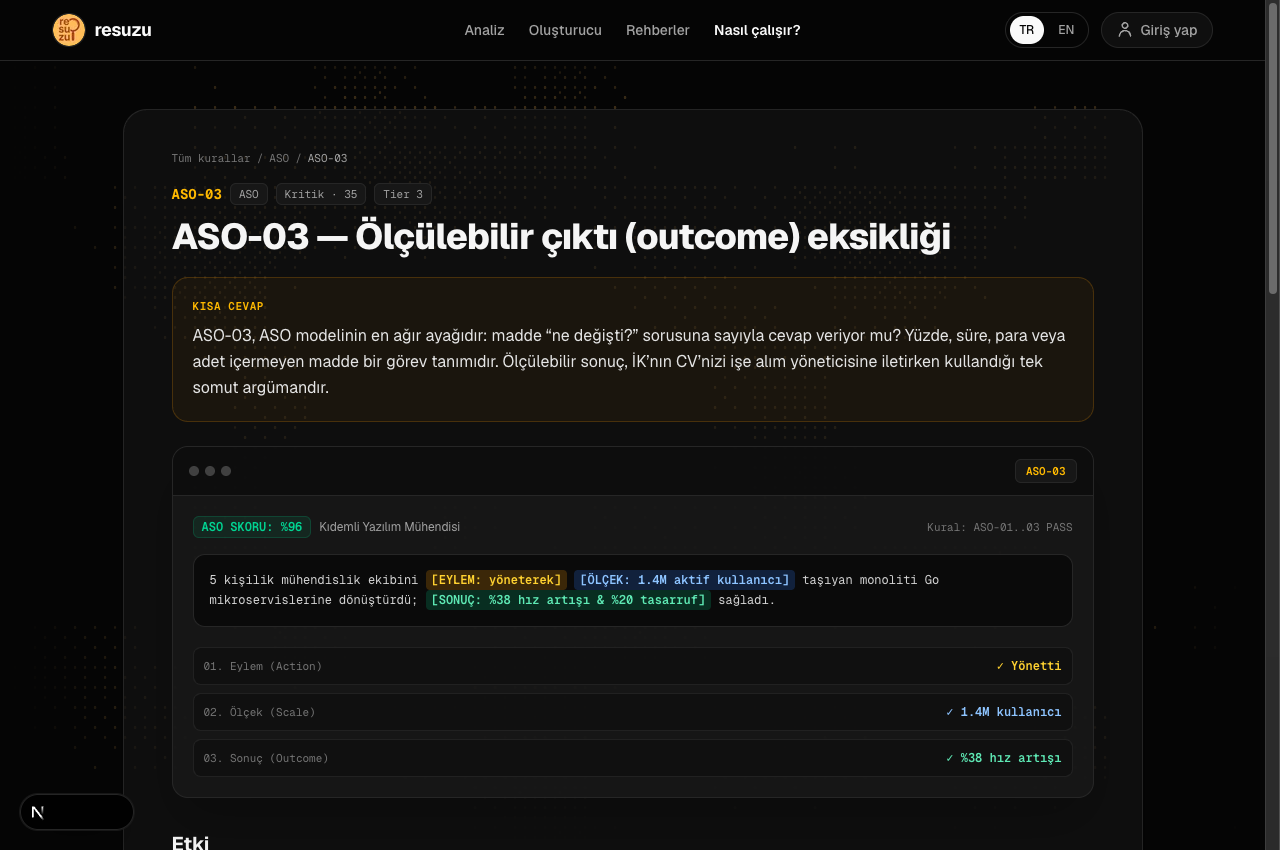
Turn all three lights green on every bullet and a 90+ score follows almost automatically.
5. Where to Find Numbers When You Think You Have None
The most common objection to ASO is genuine: "my work is not measurable". It almost always is — the metric just is not in a dashboard.
Volume. How many tickets, calls, patients, students, invoices, shipments or articles per week? "Handled 60+ support tickets weekly" is a scale figure and it costs you nothing to establish.
Scope. How many people, teams, countries, product lines or systems did the work touch? "Across four regional offices" locates the work for a reader who has no idea how big your company was.
Money. Budget managed, cost avoided, revenue influenced. You do not need a precise figure you are not allowed to disclose; "a six-figure annual media budget" is defensible and informative.
Time. What took long before and less after? Cycle time, onboarding time, month-end close, page load. Time savings are the easiest metric to reconstruct honestly, because you remember the before state.
Quality. Error rate, rework, complaint volume, audit findings, satisfaction score, retention. A nurse who reduced medication documentation errors, a teacher whose pass rate moved, an accountant who closed the books two days earlier — these are all outcomes.
If a number genuinely does not exist, state the outcome qualitatively and be specific about what changed: "eliminated the manual reconciliation step entirely" is weaker than a percentage but far stronger than "improved processes".
6. Verbs That Carry Weight, and the Ones That Do Not
ASO-01 fires on openings that describe participation rather than agency. The pattern is easy to spot once you look for it: "responsible for", "involved in", "worked on", "assisted with", "participated in", "helped", "was part of". Each of these describes proximity to work, not ownership of it.
Replace them with verbs that name what you actually did: built, designed, migrated, automated, negotiated, reduced, launched, scaled, rewrote, consolidated, standardised, recovered, trained, onboarded, audited, forecast, resolved.
One caution: ASO-04 flags repetition. Twelve bullets that all start with "Developed" read as a single sentence duplicated. Vary the verb to match the work — you did not do the same thing twelve times.
And ASO-05 flags the other failure mode: replacing a weak verb with an inflated one. "Spearheaded a paradigm-shifting initiative" is not stronger than "Built"; it is weaker, because it tells the reader nothing while announcing that you are trying.
7. Score Arithmetic — Where the Points Actually Live
The final score is a weighted sum: mechanical 30%, content 45%, ASO 25%. Each sub-score starts at 100 and drops by each failed rule's impact, scaled so that rules that could not be evaluated on your file type stay out of the denominator.
That weighting tells you where to spend effort, and it is not where most people spend it.
If your mechanical score is low, fix it first and fix it completely. These are binary, cheap and worth up to 30 points. A two-column layout and a header-only email address can cost more than every bullet on the page.
Content is the largest block at 45%, and it is mostly structural: conventional headings, consistent dates, a real summary, working links, no personal data you should not be disclosing, grouped skills, reverse chronological order. None of this requires writing talent. It requires going through the list.
ASO is 25% and it is the hardest quarter to earn — it is the only part that requires you to remember what you actually accomplished. It is also the part that carries over to the interview, which is why it is worth the time even though the point return per hour is lower.
A realistic path from 62 to 92 looks like this: mechanics take an evening and move you to the mid-70s. Structure and dates take another hour and get you to the mid-80s. The last eight points are eight bullets rewritten with real numbers, and those eight bullets are what you will be asked about when someone finally calls.
8. Rewriting Without Inflating
There is a line between a stronger bullet and a false one, and the difference is whether you can defend it under questioning.
A useful test before you finalise any rewritten bullet: imagine an interviewer reads it back to you and asks three questions. What was the baseline? Over what period? What was your specific contribution versus the team's? If you can answer all three, the bullet is safe. If any answer is a guess, revise the claim down until it is one you own.
This matters more than it sounds, because the rewrite step is where inflation creeps in. "Reduced latency by 40%" becomes "transformed system performance". "Trained four new hires" becomes "led onboarding strategy". Each step feels like improvement and each one moves you further from something you can evidence.
The honest alternative is to narrow the claim rather than widen it. "Owned the reconciliation step of the month-end close for a three-entity group" is smaller than "led financial operations" and considerably more convincing, because only someone who did the work would phrase it that way.
9. A Practical Rewrite Session
Set aside ninety minutes and work through your experience section once, in this order.
Pass one — inventory, not prose. For each role, list every distinct thing you did, in fragments, without worrying about wording. Aim for eight to twelve items per recent role. Most people stop at four and lose their best material.
Pass two — find the numbers. Go back through the list and annotate each item with any volume, scope, money, time or quality figure you can recall or reconstruct. Check old status reports, tickets, calendars and performance reviews; this is where the real metrics are. Leave blanks where there genuinely are none.
Pass three — select. Keep the three to five items per role with the strongest combination of relevance and evidence. The rest do not go on the resume; they go in a notes file you use for interview preparation.
Pass four — write. Now build the sentences: action verb, scale, outcome. One sentence each, no semicolon stacking, under about thirty words.
Pass five — audit. Run the analysis and read the ASO findings. Each one names the bullet and what is missing. Fix those specific lines rather than rewriting everything again.
The reason for the ordering is that writing first and hunting for numbers afterwards produces sentences you then try to justify. Inventory first produces claims you can already defend.
Rules Referenced in This Guide
All 36 rules →Every rule has its own inspector card, evidence sample and fix steps.
Boost Your ATS Score in Real Time
Use Resuzu Builder's live ASO evaluator to watch your resume score climb as you write.
Frequently Asked Questions
How do I quantify accomplishments in non-technical roles?
Every role has metrics. HR: time-to-hire or candidate NPS. Sales: quota attainment. Operations: hours saved through automation. Support: ticket resolution speed and customer satisfaction.
Related Guides
View All →How to Read Your Resume Analysis Report (Decoding Rule Codes & Warnings)
A step-by-step walkthrough for interpreting Resuzu audit reports, prioritizing hard blockers, and understanding ASO bullet scores.
How to Use AI for Resume Writing (Prompt Guide & Avoidable Mistakes)
Turn generative AI into an executive career strategist. Avoid cliché ChatGPT traps that get your application tossed out by human recruiters.
How to Build an ATS-Friendly Resume Step-by-Step (2026 Guide)
A comprehensive walkthrough on crafting a professional resume that passes automated Applicant Tracking Systems and impresses recruiters.