
How to Use AI for Resume Writing (Prompt Guide & Avoidable Mistakes)
Turn generative AI into an executive career strategist. Avoid cliché ChatGPT traps that get your application tossed out by human recruiters.
Large language models are a genuine force multiplier for job seekers — and one of the fastest ways to get your application discarded, if you use them the way most people do.
More than 70% of candidates prompt AI like this:
"I'm a marketing specialist. Write me an impressive resume summary."
And the model produces this:
"A highly motivated, results-oriented and innovative professional who creates synergy within dynamic teams."
The uncomfortable part: that sentence says nothing. What did you do? Which problem did you solve? Which tools? What did the company gain? None of it is there — and Resuzu's ASO-05 rule flags exactly this kind of buzzword filler.
This guide covers how to use AI as a strategist that sharpens your real achievements, not as a content inflator.
Step-by-Step Walkthrough
Feed Real Facts and Raw Metrics
Input QualityNever ask AI to invent your career from scratch. Supply concrete details, approximate team sizes, and realistic percentages.
Enforce the Action-Scale-Outcome Framework
PromptingInstruct the model: 'Convert this experience into one bullet starting with an action verb, a scale metric, and a business result.'
Prune Empty Clichés and Buzzwords
EditingStrip out generic fluff like 'passionate team player', 'go-getter', or 'spearheaded synergy'.
Validate with a Deterministic ATS Checker
VerificationRun the final text through deterministic parsing rules to ensure formatting compliance.
// TABLE OF CONTENTS
1. Prompts That Actually Work
The trick is supplying four things: a role, the raw context, explicit constraints, and the output format you want.
The template
Role: Senior technical recruiter.
Task: Rewrite the raw experience below into a single resume bullet using the ASO standard (Action, Scale, Outcome).
Constraints: No abstract adjectives ("passionate", "visionary"). Must open with a strong action verb. Keep every number I give you; never invent new ones.
Input: "..."
That last constraint matters more than it looks. A model asked to make a bullet "more impressive" will happily invent a percentage. A fabricated metric you cannot defend in an interview is worse than no metric at all.
Worked examples
Engineering:
"I worked on breaking an old monolith into microservices using React and Node.js. Pages started loading faster. Turn this into a concrete engineering achievement with a percentage or a time figure — only if I've given you one."
Sales & Account Management:
"I met with B2B customers and followed up on contract renewals. We reduced churn somewhat. Rewrite this using STAR, and tell me which number I need to supply to make it credible."
2. Five AI Clichés Recruiters Notice Immediately
- "Highly passionate and motivated..." — abstract traits you cannot evidence.
- "Creating synergy across cross-functional departments..." — corporate filler with no content.
- "Delivered innovative, game-changing solutions..." — which solution, and which metric moved?
- "Took a proactive approach aligned with business objectives..." — true of literally every candidate.
- Every bullet ending in the same cadence (e.g. "...thereby contributing critically to company success"). Uniform rhythm is the clearest tell that a model wrote the whole section.
3. Why Resuzu Splits AI From Scoring
Many tools pipe your resume through a language model and print whatever comes back. Resuzu keeps two layers strictly separate:
Layer 1 — the deterministic rules engine. All 36 rules are plain code: scannability, column detection, font family and size, contact placement, date consistency, dead links, skill grouping, ASO depth. No model is involved, so the score cannot hallucinate and the same file always scores identically.
Layer 2 — AI assistance, on request. Focused models suggest stronger verbs, point out missing metrics and draft summaries or cover letters. Output is never written straight into your document: suggestions appear in a preview where you approve, edit or reject each one.
The scoring you rely on stays reproducible, and the AI stays where it is genuinely useful — helping you express work you actually did.
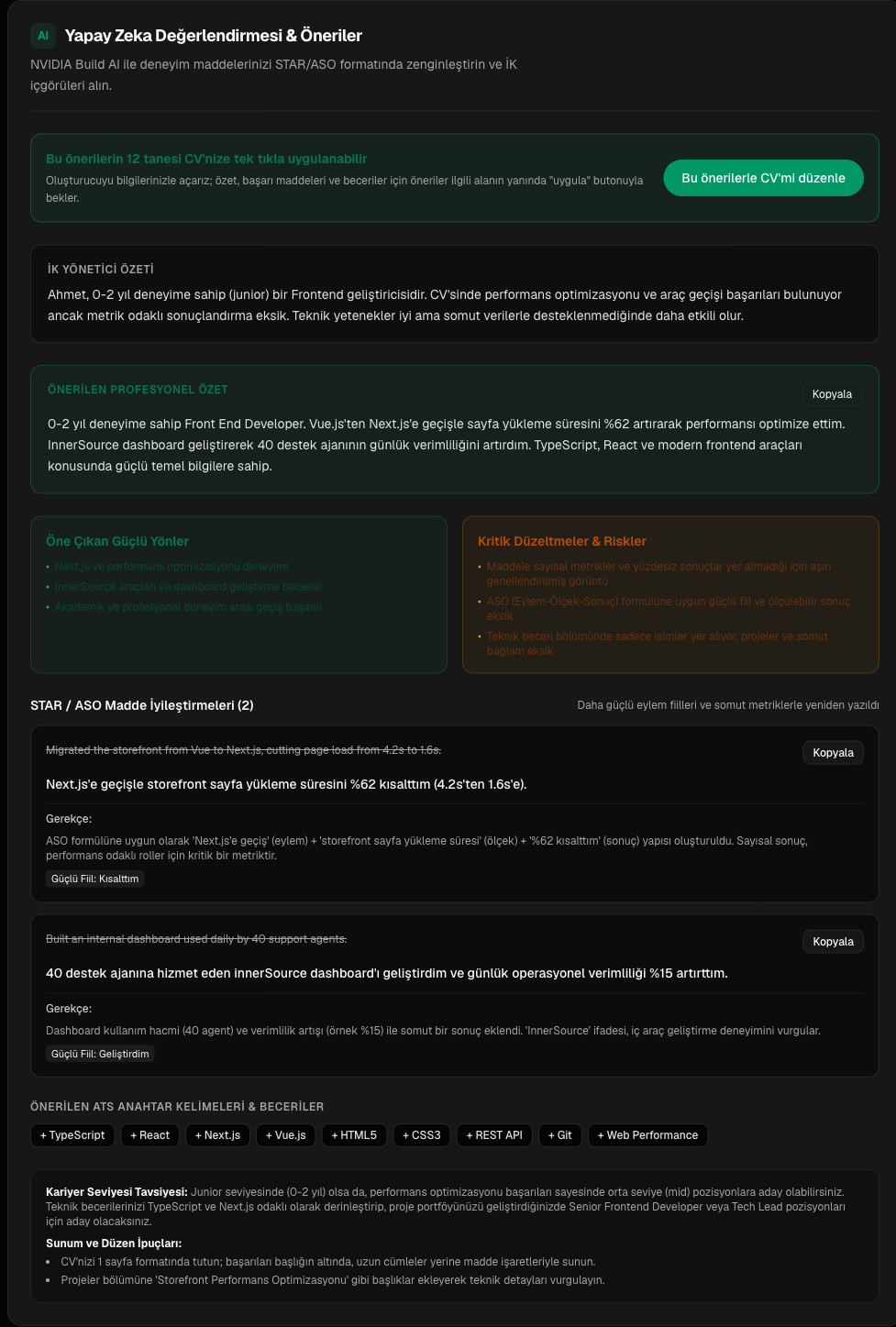
The screenshot above is the whole argument in one frame. The strikethrough line is what you wrote; underneath it is the rewrite, and under that the reasoning — which action verb was chosen, which scale was added, which outcome was made explicit. You can read the justification before you accept the sentence. A tool that simply replaced your text would give you no way to tell a good rewrite from a confident one.
4. A Prompt Library You Can Reuse
Prompts are not magic words; they are constraint sets. The four blocks below cover the situations that produce the worst AI output when left unconstrained.
Turning a responsibility into an achievement
Most bullets on most resumes are job descriptions in disguise — the thing Resuzu flags as GEN-05. If your line would still be true on the day you were hired, it is a responsibility, not an achievement.
Role: Senior recruiter in <industry>.
Task: The line below describes a responsibility. Ask me up to three questions
that would turn it into a measurable achievement. Do not rewrite it yet.
Line: "Responsible for managing the social media accounts."
Asking the model to interrogate you first is the single highest-leverage change you can make. It produces the numbers you own instead of numbers it invented.
Compressing a long paragraph
Rewrite the paragraph below as at most three bullets.
Each bullet: one strong action verb, one scale figure, one outcome.
Preserve every number exactly. If a bullet has no outcome, write
"[outcome missing]" instead of inventing one.
That last instruction is a tripwire. A model that cannot fabricate has to admit the gap, and the gap is precisely what you need to go find in your own records.
Tailoring to a specific posting
Here is a job posting and my current experience section.
List the requirements from the posting that my resume does NOT evidence.
For each, tell me whether I can evidence it from work I have actually done,
or whether it is a genuine gap I should not claim.
This is the honest version of keyword optimisation. It surfaces the vocabulary mismatch that CON-10 measures without pushing you into claiming skills you do not have — and without the keyword dumping that SKL-01 penalises.
Translating between languages
Turkish and English resumes are not translations of each other; they are different documents with different conventions. When you do move content across, the failure mode is half-translation: "Channel Operations Supervisor" becoming "Channel Operations Şefi". Instruct explicitly that function words translate and brand names do not, and review each line against its original.
5. Where AI Should Never Touch Your Resume
There are four places where model output is a liability rather than a help.
Numbers. Any figure in your resume must be one you can reconstruct in an interview. "Reduced costs by 23%" invites the question "from what baseline, over what period?" — and there is no recovering from not knowing.
Employment dates and titles. These are verified against references and background checks. A model rounding "March 2023 – July 2024" into "2023 – 2024" to make a gap look smaller creates a discrepancy on a document someone will check.
Company and product names. Models autocorrect unfamiliar names toward familiar ones. Read every proper noun after every generation.
Your voice in the summary. A professional summary written entirely by a model reads like every other summary in the stack. The strongest version is one where you supplied the sentence and the model tightened it — not the reverse.
6. The Loop That Actually Works
The reliable workflow is not "generate a resume". It is a loop with a deterministic checkpoint in the middle.
- Draft from facts. Write the raw truth in whatever language comes naturally — bad grammar, no formatting, all the numbers you remember.
- Ask the model to interrogate, then rewrite. Questions first, sentences second.
- Review each suggestion individually. Accept, edit, or reject.
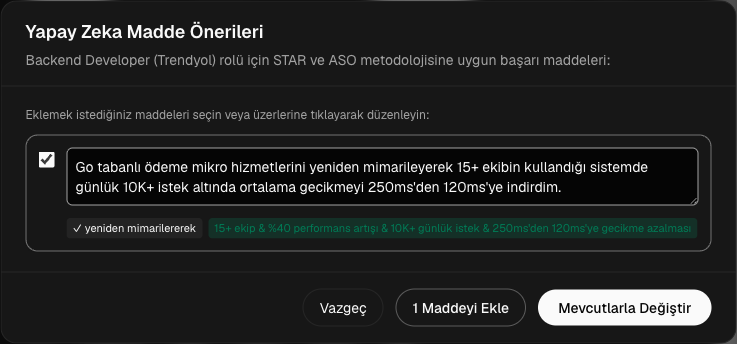
- Run the deterministic audit. The rules engine does not care how the text was produced; it measures whether the result is parseable and evidenced. If ASO-03 still fires, the rewrite added adjectives rather than outcomes.
- Repeat on the specific bullets that failed — not on the whole document.
Steps 3 and 4 are what separate a resume that survives a recruiter's second read from one that impresses for three seconds and then collapses under a single follow-up question.
7. Cover Letters and Interview Preparation
Cover letters are where AI earns its keep, because the task is genuinely repetitive: the same evidence, re-argued against a different posting each time. Give the model the posting and your actual experience, and ask it to argue from specific evidence rather than restating the posting back at the employer. A letter that could be sent to any company will be read as exactly that.
Interview preparation is the mirror image. Feed the model the bullets you just wrote and ask it to attack them: "For each bullet, write the follow-up question a skeptical interviewer would ask." If you cannot answer one of those questions, the bullet is not ready — and you have found the problem before the interview rather than during it.
Rules Referenced in This Guide
All 36 rules →Every rule has its own inspector card, evidence sample and fix steps.
Supercharge Your Bullets with Resuzu AI
Leverage Resuzu's deterministic rule engine coupled with AI suggestions to format bullet points recruiters love.
Frequently Asked Questions
Can recruiters tell if I used ChatGPT for my resume?
If you copy-paste generic text filled with buzzwords like 'visionary professional with proven track record', yes. Recruiters see these phrases dozens of times a day. However, when AI is constrained by real metrics and structured action verbs, it reads like high-caliber professional writing.
Related Guides
View All →How to Boost Your Resume ATS Score from 60 to 90+ (Proven ASO Formula)
Transform a mediocre resume into an elite application using Google's X-Y-Z principle and the Action-Scale-Outcome (ASO) methodology.
Interview Mode: Build a Professional Resume Through Q&A
Overcome blank-page anxiety. Answer targeted interview questions in plain language and let AI generate an ATS-ready resume draft.
How to Read Your Resume Analysis Report (Decoding Rule Codes & Warnings)
A step-by-step walkthrough for interpreting Resuzu audit reports, prioritizing hard blockers, and understanding ASO bullet scores.