
Interview Mode: Build a Professional Resume Through Q&A
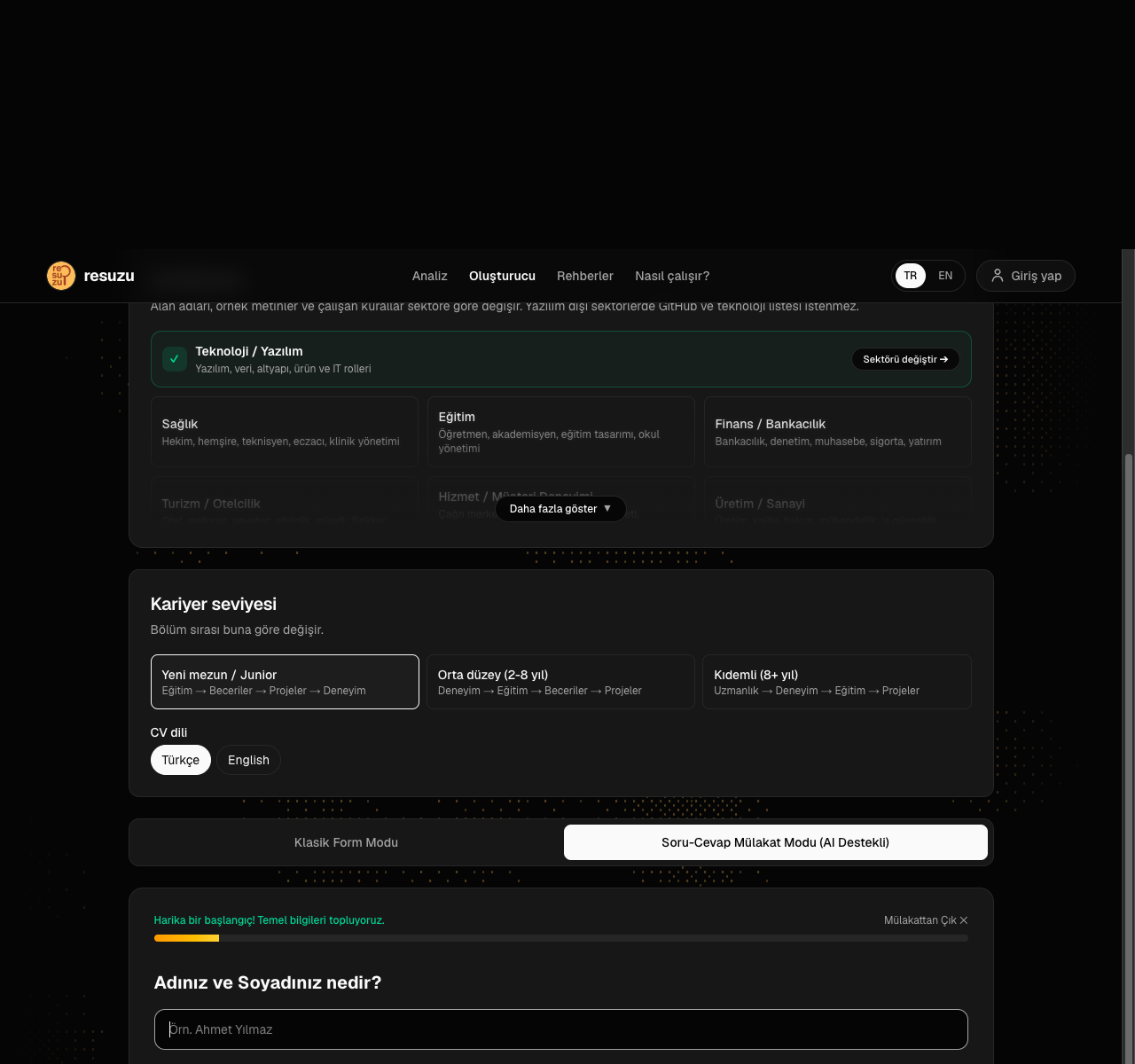
Overcome blank-page anxiety. Answer targeted interview questions in plain language and let AI generate an ATS-ready resume draft.
What actually stops people from finishing a resume? Not ambition, and usually not experience. Surveys put around 68% of job seekers in front of the same wall: blank page syndrome.
Not knowing where to start, struggling to describe past work in professional language, worrying about formatting — it burns hours and often ends with the file closed again.
Resuzu Interview Mode exists to remove that step entirely.
Step-by-Step Walkthrough
Select Industry and Seniority
Step 1Choose your focus area (Software, Marketing, Finance, Sales, Engineering) and level (Junior, Mid, Senior).
Answer Guided Questions Naturally
Step 2Respond to prompts like 'What was your primary achievement in your last role?' without worrying about corporate jargon.
Watch AI Stream Structured Bullets
Step 3Resuzu AI parses your raw input into quantified, action-oriented bullet points adhering to international ATS standards.
Review, Polish, and Download
CompleteFine-tune the draft in the Builder editor and export a clean PDF ready for job submissions.
// TABLE OF CONTENTS
1. How Interview Mode Works
Instead of filling in a form, imagine talking through your career with an experienced recruiter over coffee.
Interview Mode asks you a sequence of questions chosen for your industry:
- "What was your biggest contribution to the team or company in your last role?"
- "Which three tools or technologies did you rely on day to day?"
- "Describe a difficult problem you solved — what happened as a result?"
You answer in ordinary language, the way you would speak. The AI layer then converts those raw answers into professional bullets that follow the ASO (Action, Scale, Outcome) standard, and assembles them into a complete draft — contact block, summary, experience entries, education and skills.
Nothing is written to your resume without your approval. The synthesised draft lands in the Builder, where you review and edit every field before exporting.
2. From Raw Answer to Resume Bullet
Here is a real transformation:
What you type
"I was on the marketing team, ran the social accounts and sent email newsletters. Our followers went up and it helped sales a bit."
What Resuzu produces
"Owned social media channels and the weekly email marketing programme end to end, growing the organic audience by 45% in six months and lifting email-attributed revenue by 18%."
Three things changed:
- A passive description became a strong action (owned ... end to end).
- Vagueness became measurable scale (45% in six months).
- "Helped sales a bit" became a concrete outcome (18% revenue lift).
One caveat worth stating plainly: the model sharpens the language, it does not invent your numbers. If you say "followers went up", you will be prompted for the figure. A metric you cannot defend in an interview is worse than no metric at all.
3. Who Interview Mode Suits Best
- Early-career candidates. Graduates who have done real work in projects and internships but don't know how to present it professionally.
- Career changers. Professionals who need to reframe existing experience for a different industry — the questions adapt to the sector you select.
- Anyone short on time. If you don't want to fight with templates, margins and alignment, you can be application-ready in minutes.
- Candidates writing in a second language. Interview Mode runs in Turkish and English, and the output language is enforced on the result, not just requested in the prompt — so a Turkish answer produces a genuinely Turkish resume, and an English one produces English.
4. Your Turn
Pick your sector, answer the questions in your own words, and review the draft. From there it is a single click to a clean, single-column, ATS-safe PDF.
5. What the Questions Are Actually Doing
The question list is not a form with friendlier labels. It is built around the observation that people describe their work badly when asked to describe their work, and well when asked about specific events.
"Summarise your responsibilities" produces a job description. "Describe a difficult problem you solved and what happened as a result" produces a story with a beginning, a scale and an ending — which is exactly the material an ASO bullet needs. The questions are structured to extract the three components you would otherwise have to remember to include.
The set adapts to the sector you pick. A nurse is not asked about repositories; a developer is not asked about patient volumes. This matters more than it sounds: generic career questions produce generic answers, and a candidate in hospitality who is asked about "technologies used" will either skip the question or answer it uselessly.
You can also skip any question. An unanswered question produces no invented content — the corresponding field simply stays empty in the draft and you fill it in the Builder, or leave it out.
6. What Happens Between Your Answer and the Draft
The synthesis step is the most expensive call in the product, and it is worth knowing what it does and does not do.
It does restructure: splitting a rambling answer into distinct bullets, choosing an action verb, placing the scale figure you supplied, and stating the outcome explicitly. It maps your answers onto a complete resume skeleton — contact, summary, experience entries with company, title and dates, education, skills grouped into categories.
It does not invent facts. Dates, company names and numbers come from your answers. Where a bullet has no outcome because you did not give one, it stays without one and the analyser will flag it later — which is the correct behaviour, because the alternative is a number you cannot defend.
Parsing free text has its own pitfalls, and the contact question is the clearest example. A single line like Elif Demir | [email protected] | 0532 111 22 33 | İstanbul has to be decomposed correctly: email and phone are extracted first and removed, and only then is the remainder read for a location. Done in the wrong order, the digits inside an email become a phone number and the email itself becomes a city — and that city gets printed on your PDF.
7. Interview Mode and Actual Interviews
There is a second use for the mode that has nothing to do with writing.
The questions it asks are close to the ones you will face in a screening call: what you contributed, what you used, what went wrong and what you did about it. Answering them in writing forces you to reconstruct the details — the numbers, the timeline, the scope — while you have time to look things up.
By the time a recruiter asks "tell me about a difficult problem you solved", you have already written the answer down, attached a figure to it, and read it back. That preparation is worth more than the resume it produced.
A practical suggestion: keep your raw answers. The draft that reaches the Builder is the compressed version; the original text has detail that does not fit on a resume but is exactly what you want in front of you before a call.
8. After the Draft
The draft is a starting point, not an output. Three things are worth doing before you export.
Check every number. The model placed the figures you gave it; confirm each one is the figure you meant and that you can reconstruct how it was calculated.
Check the proper nouns. Company names, product names and institution names are where autocorrection toward familiar spellings shows up.
Run the analysis. A draft that came out of Interview Mode passes the mechanical rules by construction — it is generated as a single-column PDF with embedded fonts and real link annotations — but content rules still apply. Missing dates, a thin summary or bullets with no outcome will show up, and those are the fields to go back and fill.
If you want to change the resume's language afterwards, use the translation step rather than the language toggle. The toggle changes the PDF labels and the language of future AI output; it does not translate content you have already written. Translation is a separate pass that shows the original and the translation side by side for line-by-line approval — because a model that mangles a job title should be caught next to the original, not discovered on a document you already sent.
Rules Referenced in This Guide
All 36 rules →Every rule has its own inspector card, evidence sample and fix steps.
Try Interview Mode for Free
Spend 5 minutes answering tailored questions and get a fully formatted, ATS-compliant resume without the hassle.
Frequently Asked Questions
Is Interview Mode free to use?
Yes, Resuzu Interview Mode is 100% free with no registration or payment required.
Are my responses stored on any database?
No. Resuzu operates on a strict RAM-only, zero-storage policy. Everything is processed transiently in your browser session.
Related Guides
View All →How to Use AI for Resume Writing (Prompt Guide & Avoidable Mistakes)
Turn generative AI into an executive career strategist. Avoid cliché ChatGPT traps that get your application tossed out by human recruiters.
How to Build an ATS-Friendly Resume Step-by-Step (2026 Guide)
A comprehensive walkthrough on crafting a professional resume that passes automated Applicant Tracking Systems and impresses recruiters.
How to Boost Your Resume ATS Score from 60 to 90+ (Proven ASO Formula)
Transform a mediocre resume into an elite application using Google's X-Y-Z principle and the Action-Scale-Outcome (ASO) methodology.